

Mr. Benson and the Empty Cross

cross-jesus-bible-god-161034.jpeg

pexels-photo-792953.jpeg

When I went to 5th grade Sunday School, my teacher was Mr. Benson. One experience with him left a powerful impression on me. We had recently moved to Cincinnati and many of my new friends were Catholics. They had crucifixes in their home and even their bedrooms. I asked Mr. Benson why our cross, as Presbyterians, was empty.

Mr. Benson told me that we were both Christians, but emphasized different points about the gospel. The Catholics, he said, want their people to remember always Jesus’ sacrifice on the cross. That God loves us so much that he gave his son as the sacrifice for our sins. Presbyterians and Protestants, he said, emphasize Jesus’ resurrection and new life. We focus on his victory over death and the promise of his coming again.

Even as a 5th grader I “got it.” I saw the value of both the crucifix and the empty cross. It’s not a matter of “right or wrong,” or “better or worse.” It’s a matter of emphasis. Both together convey God’s love in sending Jesus to take our place in death so that he could defeat death and be present with us now and forever.

The empty cross testifies to God’s death-breaking, life-changing power. In Christ, the cross transformed:

Humiliation into glory

Pain into the prize of eternal life

Denial into unwavering devotion

The worst of human deeds into the greatest of God’s wonders

Which expression means the most to you at this time?

Maybe you appreciate the message of the crucifix: that there’s no limit to God’s love. It is the sign we can trust God to care for us in every way.

What, then, shall we say in response to these things? If God is for us, who can be against us? 32 He who did not spare his own Son, but gave him up for us all—how will he not also, along with him, graciously give us all things? (Romans 8:31-32 NIV)

Or maybe you appreciate the promise of the empty cross representing God’s resurrection power at work in every challenge and opportunity in life.

I have been crucified with Christ and I no longer live, but Christ lives in me. The life I now live in the body, I live by faith in the Son of God, who loved me and gave himself for me (Galatians 2:20 NIV).

Never lose sight of Jesus’ cross. No other symbol conveys God’s love and power more clearly.

“For the Cross means that even when things are at their worst, even when life does not bear thinking about, God is master of the situation still, and nothing can spoil His final pattern or defeat His purpose of love” (James Stewart, Heralds of God, p. 78).

Thank you, Mr. Benson!

 

The Paradox of Power

Pitcher and Basin shutterstock_1036218550

Eugene was a big man who towered over me. He put one hand on my left shoulder, one on my right, looked me straight in the eye and said in a resonant voice that was heard throughout the room, “In my country, when they make you a king, they make you a slave.”

I had just been installed as senior pastor of First Presbyterian Church, Fairfield, Connecticut, and was at the reception following the service. In that congregation there was a wonderful extended family from Ghana in West Africa. Eugene was “head” of the family. He was a former officer in the Ghanaian army, and still stood straight and had a commanding presence.

His words echoed in my ears and went straight to my heart, “In my country, when they make you a king, they make you a slave.” Eugene continued his loving exhortation by saying that people need a leader who protects, provides and cares for them. “The good leader knows,” he said, “that the welfare of the people means his own security and well-being, too.”

I imagine you may find it a bit jarring to compare a pastor to a king, or hear an African speak openly about slavery. But Eugene’s point is clearly consistent with Jesus’ message. In John 13, just hours before his betrayal, trial and crucifixion, Jesus showed his disciples the way of power in God’s Kingdom.

After washing their feet, he put on his robe again and sat down and asked, “Do you understand what I was doing? You call me ‘Teacher’ and ‘Lord,’ and you are right, because that’s what I am. And since I, your Lord and Teacher, have washed your feet, you ought to wash each other’s feet. I have given you an example to follow. Do as I have done to you. I tell you the truth, slaves are not greater than their master. Nor is the messenger more important than the one who sends the message. Now that you know these things, God will bless you for doing them” (John 13:12-17 New Living Translation).

Leaders need to understand the nature of power. Power is framed differently in God’s Kingdom as opposed to the world. In the world, power is a sign of prestige; in God’s Kingdom, power is vested in servants. In the world, power is a tool for self-gratification; in God’s Kingdom, power is a means to show love. In the world, power is often exercised through personal intimidation; in God’s Kingdom, power is dying to self.

A number of years ago, I developed the book TouchPoints for Leaders as part of the Tyndale House Publishers TouchPoints  series. It contains over 150 topics with Scriptures and comments I wrote applicable to leadership issues. Don’t let that word ‘leader’ throw you if you think, “I’m not a leader.” Leaders are, most simply, people with influence. This influence can be formal (like a teacher or a coach) or, more likely, informal (as in the influence you have with friends, colleagues, and family members). Here’s what I wrote as one of the entries under “Power:”

Leaders have the ability to influence others, to mobilize resources, and to get the attention of significant people or groups of people in society. They can make things happen– or keep things from happening. In short, they have power to control. This is the most seductive aspect of leadership– but is also at the heart of effectiveness. Ultimately, however, leaders in all walks of life are dependent on God’s power.

Many passages in Scripture remind us that us we are stewards, not originators, of power.

“…’It is not by force nor by strength, but by my Spirit,’ says the LORD Almighty” (Zechariah 4:6 NLT).

“…He [the Lord] did it so you would never think that it was your own strength and energy that made you wealthy. Always remember that it is the LORD your God who gives you power to become rich” (Deuteronomy 8:17-18 NLT).

“…For apart from me you can do nothing” (John 15:5 NLT).

“And who is adequate for such a task as this? . . . It is not that we think we can do anything of lasting value by ourselves. Our only power and success come from God” (2 Corinthians 2:16, 3:5 NLT).

“There are no ‘self-made’ people who have power in and of themselves. They cannot claim responsibility for their birth, their genetic makeup, nor the political, economic and social circumstances and times into which they were born. God allows us to live at the time and place of his choosing. Wise leaders continually remember where their power comes from so that they use it in accordance with God’s values and will.” (TouchPoints for Leaders, Wheaton, IL, Tyndale House Publishers, 2004, page 181).

The more you use power for self-advancement, the less you really have. Power used in selfless ways grows giving glory to God and blessing to others.


If Angels Could Envy


pexels-photo-460390.jpeg

I have been fascinated by the thought that our faith, in and of itself, glorifies God. This shouldn’t surprise us when we think about the way a person’s faith in us expresses affirmation and inspires our best effort. When someone says, “I know you can handle this,” that faith itself energizes us.

The rest of the “spiritual world” — angels and the “principalities and powers” (Ephesians 6:12)– knows “by experience” the reality of God. James affirms that even the demons believe. “You believe that God is one; you do well. Even the demons believe—and shudder” (James 2:19 RSV).

We alone, humanity created in God’s image, experience God by faith. We alone “walk by faith and not by sight” (2 Corinthians 5:7). Why? I think it is, in part, to glorify God in the eyes of the rest of the spiritual world. When the angels see our faith, they give glory to God. When the powers of darkness see our faith, they are baffled and discouraged. Our trust now honors God in a way unlike those who experience God “directly” in the spiritual world.

The first seeds of this thought were planted by a quote from Forbes Robinson in a book I often read for soul nourishment. It’s advice to a young pastor that easily applies to all of Jesus’ followers.

I think I have told you of my father’s words spoken during his last illness: “If I had a thousand lives I would give them all, all to the ministry.” You will not regret your decision.  If angels could envy, how they would envy us our splendid chance, to be able, in a world where everything unseen must be taken on sheer faith, in a world where the contest between the flesh and the spirit is being decided for the universe, not only to win the battle ourselves but also to win it for others!  To help a brother [or sister] up the mountain while you yourself are only just able to keep your foothold, to struggle through the mist together, that surely is better than to stand at the summit and beckon.

Forbes Robinson quoted in John W. Doberstein, Minister’s Prayer Book (Philadelphia, PA, Fortress Press, 1986), 203-04.

Jesus affirmed this in his post-resurrection encounter with “doubting Thomas”:

Then he said to Thomas, “Put your finger here, and see my hands; and put out your hand, and place it in my side; do not be faithless, but believing.” Thomas answered him, “My Lord and my God!” Jesus said to him, “Have you believed because you have seen me? Blessed are those who have not seen and yet believe” (John 20:27-29 RSV).

So what? Glorifying God is more than praise and worship. We glorify and honor God when we show the world that God is able to do more than we could ever ask or imagine (Ephesians 3:20-21).

I am learning to say to myself over and over again, “God’s got this.”

Worried about your job? “God’s got this.”

Concerned about your future? “God’s got this.”

Caught in a conflict? “God’s got this.”

Waiting and waiting and waiting and waiting for an answer to your prayer? “God’s got this.”

Faith is not simply what you believe. It is believing now, trusting now, resting confidently on God’s grace and wisdom and ultimate goodness now.

So here’s a prayer to awaken your faith, “Lord, help me bring glory to you by trusting you now. You got this! Amen!”


How can I know God cares?

Bedford Baptist Church
First Baptist Church of Bedford, Massachusetts

I think most of us have a hard time believing God really cares, really loves us, and is really watching what goes on in our lives. Then you have one of those experiences that makes it clear.

During my first two years of seminary I served as an intern at First Baptist Church in Bedford, Massachusetts. Of the many special people there, Paul and Elsa had become dear friends. They were a couple in their early sixties who knew and shared the joy of the Lord. Paul was a school teacher and Elsa was a nurse who worked in order to provide the financial means necessary to care for their developmentally-disabled grown daughter.

On my last day there Paul and Elsa arrived early, before the evening service. They asked to speak to Sarah and me privately. They shared how much they had enjoyed our two years with their congregation. They handed us a card but said, “Now before you open it, we need to tell a story.”

“Elsa and I have been praying for you two daily for the past few weeks,” began Paul. “One morning the Lord impressed on my heart that we were to give you something special. I was a bit surprised by what he seemed to want, but I prayed about it and decided to talk it over with Elsa.”

“What Paul didn’t know,” chimed in Elsa, with a sparkle in her eyes, “was that the Lord was saying the same thing to me.”

When they discussed it together they were pleasantly surprised to find that God had put the same idea on the their hearts at the same time!

“God wants you to have this! So go ahead and open the card!”

I opened it, and out fell a check.

“We had each written down the amount the Lord told us on a piece of paper, traded papers and opened them at the same time— and it was the same amount.”

It was a check for $500! From this dear couple who had little “extra” to share.

“We felt the Lord wanted you to have this as you start your family.”

I was speechless. Sarah and I both were moved to tears. How could Paul and Elsa have known that we had been praying about starting our family? The gift of money itself was amazing, but their sense of the purpose for the money showed God’s care in a way I had never seen it before. The Lord moved through others to supply a need we hadn’t shared with another soul. (I told this story in my book Questions God Asks, Questions Satan Asks, Wheaton: Tyndale House Publishers, 1988, p. 234-235.)

I have never been able to share that story without tears welling up in my eyes. God is so good. Worry denies or distracts us from the evidence that God takes care of us every single day– even if we don’t notice it.

“So don’t worry about these things, saying, ‘What will we eat? What will we drink? What will we wear?’ These things dominate the thoughts of unbelievers, but your heavenly Father already knows all your needs. Seek the Kingdom of God above all else, and live righteously, and he will give you everything you need” (Matthew 6:31-33 NLT).

The Lord used Paul and Elsa to convince us, as we stood poised on the brink of ministry, that he literally knows our needs before we even ask him. Bless the Lord– and bless his people who listen and are part of his provision.

“For we live by faith, not by sight” (2 Corinthians 5:7 NIV)

Now some of you may not have a dramatic story like this to share. Or it could be that you may have forgotten that time (or those times) God truly showed his grace and mercy. We walk by faith, not by sight—but always watch to see God’s hand at work. When God works, write it down in your journal—and go back to it often to fuel your faith and gratitude.


Billy Graham’s Doubts

Doug & Billy Graham
Meeting with Dr. Graham in Kansas City in 2004

The death of Dr. Billy Graham brought back some very special memories for me. Dr. Graham handed me my diploma at graduation from Gordon-Conwell Seminary. Then, over 25 years later, I had the privilege of being part of the pastors’ invitation team for Billy’s final full crusade in Kansas City, at Arrowhead Stadium, October 7-10, 2004. More on that in a moment.

First, let me share a story that has had a powerful impact on me about how he handled his personal doubts and misgivings about God’s Word. Billy described this situation in an article in the very first issue of the magazine he helped found, Christianity Today, published on October 15, 1956. Here is a portion of it (reprinted in Christianity Today, October 22, 1976) in his own words:

In 1949 I had been having a great many doubts concerning the Bible. I thought I saw apparent contradictions in Scripture. Some things I could not reconcile with my restricted concept of God. When I stood up to preach, the authoritative note so characteristic of all great preachers of the past was lacking. Like hundreds of other young seminary students, I was waging the intellectual battle of my life. The outcome could certainly affect my future ministry.

In August of that year I had been invited to Forest Home, a Presbyterian conference center high in the mountains outside Los Angeles. I remember walking down a trail, tramping into the woods, and almost wrestling with God. I dueled with my doubts, and my soul seemed to be caught in the crossfire. Finally, in desperation, I surrendered my will to the living God revealed in Scripture. I knelt before the open Bible and said: “Lord, many things in this Book I do not understand. But thou hast said, ‘The just shall live by faith.’ All I have received from thee, I have taken by faith. Here and now, by faith, I accept the Bible as thy Word. I take it all. I take it without reservations. Where there are things I cannot understand, I will reserve judgment until I receive more light. If this pleases thee, give me authority as I proclaim thy Word, and through that authority convict me of sin and turn sinners to the Savior.”

Within six weeks we started our Los Angeles crusade, which is now history. During that crusade I discovered the secret that changed my ministry. I stopped trying to prove that the Bible was true. I had settled in my own mind that it was, and this faith was conveyed to the audience. Over and over again I found myself saying, “The Bible says….”  I felt as though I were merely a voice through which the Holy Spirit was speaking.

Authority created faith. Faith generated response, and hundreds of people were impelled to come to Christ. A crusade scheduled for three weeks lengthened into eight weeks, with hundreds of thousands of people in attendance. The people were not coming to hear great oratory, nor were they interested merely in my ideas. I found they were desperately hungry to hear what God had to say through his Holy Word.

I saw that faith demonstrated at the 2004 Kansas City Crusade when I sat on the platform with Dr. Graham. What I remember most is how frail he seemed—until he stepped up to preach. At that moment, he was 30 years younger! It was like he grew in size and energy—like going from a lamb to a lion. And then, when he completed his message and invitation, he was back to the lamb.

For the word of God is alive and active” Hebrews 4:12 (NIV)

God’s Word is Living and Active—in more ways that we can imagine. Thank you, Dr. Graham, for being a witness to that. Glory to God.


Soul Breaks

pexels-photo-448835.jpeg

The title “Soul Breaks” could suggest many subjects, but I’m using it in the sense of a break time for spiritual nourishment, for refreshment—like “coffee break” or “lunch break.” Breaks are essential to pace us in the midst of life’s workload and responsibilities. How do we make the most of our “breaks”?

It may help to begin with the importance of spending a significant amount of time with the Lord each day for Bible reading, prayer and seeking God’s leading for the day. People debate about the best time for a “quiet time” with the Lord. Most opt for morning, based on Jesus’ practice described in Mark 1:35, “Very early in the morning, while it was still dark, Jesus got up, left the house and went off to a solitary place, where he prayed” (NIV). Others say they spend time with God in the evening. I’ve always based my choice on the observation that the best time for a musician to tune her instrument is before the performance, rather than after it.

This discussion, however, too often misses our need for spiritual nourishment throughout the day. “Soul breaks” can be opportunities for spiritual reading. Spiritual reading is reading for the heart. Our focus is not on assimilating content, but on using the reading to deepen our awareness of God and of the many-faceted spiritual dynamics at work in our lives.

The best comparison is the difference between reading the newspaper and reading a love letter.

The newspaper is given a quick scan and discarded. A brief love note, however, is read over and over again, not for the content, but for the sense of presence and emotional connection it inspires.

When we read in this way, we savor the message, prayerfully letting the words soak into our hearts and minds. The goal of the reading is to put us in touch with the Lord. The classic expression of this discipline comes from Baron Friedrich von Hügel (1852-1925), an Austrian Catholic layman who served as a spiritual director to many.

“That daily quarter of an hour, for now forty years or more, I am sure has been one of the greatest sustenances and sources of calm for my life. Of course, such ‘reading’ is hardly reading in the ordinary sense of the word at all. As well could you call the letting a very slowly dissolving lozenge melt imperceptibly in your mouth ‘eating’. Such reading is, of course, meant as directly as possible to feed the heart, to fortify the will–to put these into contact with God–thus, by the book, to get away from the book to the realities it suggests…”  Baron Friedrich von Hügel, cited in John Baillie, A Diary of Readings (New York: Scribner’s Sons, 1955), Day 1.

The goal is not quantity, nor is it the intellectual mastery of content. Spiritual reading could also be compared to taking a vitamin tablet. The size of the tablet is small compared to a normal meal, yet it gives essential nutrients to our bodies. So with spiritual reading. A small portion can help fortify the soul for the day.

How do you practice spiritual reading? Read a little (usually from a classic devotional book like Oswald Chambers My Utmost for His Highest or a book on spiritual growth) then stop when you come to one thought that stirs your spirit. It “jumps out at you.” That is a morsel of grace for you to savor. That’s the “lozenge” von Hügel mentions. Sit still and meditate on it. Journal it. Write the phrase or sentence at the top of a fresh page of paper then write your heart-response to it. You may turn it into a prayer. Then, return to it at the end of the day, reflecting on what it meant.

I could list dozens and dozens of books (and have in my book, SoulShaping, page 272), but I’ll leave that to your discovery. And, by the way, I hope this blog provides a Soul Break for you.

Getting God’s Attention?

church-trappist-georgia-monastery-62285.jpeg

How do I connect with God?

Is there something I need to do?

Do I have to impress God?

Does God really care? I’m not so sure God wants to connect with me!

Deep down, many of us have questions and feelings like these. We’re entering the season of Lent when Jesus’ followers give focused attention to these questions. But there is a fundamental assumption that must be addressed to determine whether Lent is a season of effort or a season of freedom. Before we consider that, what is Lent?

Lent is one of those old “churchy” words that seems to be coming back into use as Jesus’ followers explore the practice of the “Christian Year.” One of the fascinating trends in spiritual formation has been called “ancient-future worship” (a term coined by Robert E. Webber) in which Jesus’ followers are blending ancient practices of God’s people with contemporary worship and spirituality. There’s a new appreciation for tradition, especially when it is distinguished from traditionalism.

Tradition is the living faith of the dead; traditionalism is the dead faith of the living.  Tradition lives in conversation with the past, while remembering we are where and when we are and that it is we who have to decide.  Traditionalism supposes that nothing should ever be done for the first time, so all that is needed to solve any problem is to arrive at the supposedly unanimous testimony of this homogenized tradition.

SOURCE: Christianity Today, Jaraslav Pelikan in an interview in U.S. News and World Report (June 26, 1989).

Symphonic composer Gustav Mahler said, “Tradition is not the worship of the ashes, but the keeping of the fire!” Tradition is a gift given us from previous generations to be understood, assessed and reinterpreted in our day. Remember, we will pass our tradition to those who follow. May they see it as fire, not ashes.

The Christian Year includes Advent, Christmas, Epiphany, Lent, Holy Week, Eastertide, Pentecost and Kingdomtide or Ordinary Time. The season of Lent begins with Ash Wednesday and lasts for eight Sundays, followed by Holy Week which includes Maundy Thursday, Good Friday and Easter. The word “Lent” comes from an Old English word that simply refers to the lengthening of days as we enter Spring time. It is not a theological term, but speaks about the changing of the seasons. Lent is a penitential season. We prepare our hearts for the Easter message by focusing on our sin and our need for repentance and salvation. The forty days of Lent (which do not count Sundays because Sundays are always ‘Resurrection days’ for believers) also remind us of Israel’s forty years in the wilderness and Jesus’ forty days in the desert.

One of the themes of Lent is fasting, abstaining in full or in part from particular foods and/ or activities. Here’s where we get back to my opening question: Is Lent a season of effort and obligation or a season of freedom? In my experience, many view fasting as a way of showing God they sincerely regret their spiritual apathy and repent from their sin. In other words, it could be seen as their way of getting God’s attention. As if God will really pay attention to them because of their exceptional efforts. Please understand, I am not devaluing these efforts. But I think we need to examine our theological assumptions if we think we need to impress God with our sincerity to get God’s attention.

Scripture gives countless assurances that we have God’s continual attention:

Psalm 139 (selected verses)
1 O Lord, you have examined my heart
and know everything about me.
2 You know when I sit down or stand up.
You know my thoughts even when I’m far away.
3 You see me when I travel
and when I rest at home.
You know everything I do.
4 You know what I am going to say
even before I say it, Lord.
5 You go before me and follow me.
You place your hand of blessing on my head.
6 Such knowledge is too wonderful for me,
too great for me to understand!
7 I can never escape from your Spirit!
I can never get away from your presence!…
13 You made all the delicate, inner parts of my body
and knit me together in my mother’s womb…
16 You saw me before I was born.
Every day of my life was recorded in your book.
Every moment was laid out
before a single day had passed.

Jesus said, “What is the price of five sparrows—two copper coins? Yet God does not forget a single one of them. And the very hairs on your head are all numbered. So don’t be afraid; you are more valuable to God than a whole flock of sparrows (Luke 12:6-7 NLT).

You see, the problem isn’t God’s attention, it’s ours! The spiritual disciplines, including fasting, are tools, means, practices and habits to enable us to develop a deeper awareness and mindfulness of God. As we truly repent, we are not earning God’s grace. We are receiving it more fully.

In Lent we don’t give things up to get God’s attention, but to give God our attention.


“Lord, you have a problem here…”

pexels-photo-257037.jpeg

I was talking with a friend who had experienced a remarkable healing from cancer. It was hard to distinguish between the effectiveness of medicine and the power of prayer, but my friend, Laura, gave God the glory. Then after a number of years the cancer returned.

“I’ve told everyone God healed me. Now what?” she asked through tears.

“So what are your prayers like now?” I asked.

She said, with a smile breaking through the tears, “I’ve been saying, ‘Lord, you have a problem here!’”

I never thought of a prayer like that. At first it seemed a bit presumptuous to me, as if God were obligated to help her for the sake of his own reputation. But her spirit was humble. She was trusting God, not testing God. So I continued exploring Scripture with her prayer in mind.

You do not have because you do not ask God. When you ask, you do not receive, because you ask with wrong motives, that you may spend what you get on your pleasures (James 4:2-3 NIV).

Laura was not being selfish. She truly wanted people to be encouraged to trust God because of her story.

“You parents—if your children ask for a loaf of bread, do you give them a stone instead? 10 Or if they ask for a fish, do you give them a snake? Of course not! 11 So if you sinful people know how to give good gifts to your children, how much more will your heavenly Father give good gifts to those who ask him” (Matthew 7:9-11 NLT).

Countless scriptures call us to pray based on God’s love for us as cherished children. God wants to be part of our lives and for us to be equipped for his work.

I began to realize I often limited my prayers to my own imagination. If I couldn’t see a practical, reasonable answer, then I wasn’t sure how to pray. Laura released her concern to the Lord, without any need to “filter” her request through questions like, “What’s really possible now?” or “Lord, how could you ever do this?”

I experienced a breakthrough in prayer when I realized I didn’t have the figure out the answer to my prayer. I could just lay the problem at the Lord’s feet—and let go. It wasn’t up to me to solve it. I learned to say, “Describe, don’t prescribe.” Don’t try to tell God how to make it happen.

Humble yourselves, therefore, under the mighty hand of God so that at the proper time he may exalt you, casting all your anxieties on him, because he cares for you (1 Peter 5:6-7 ESV).

I hope you understand what I mean when I say I think God enjoys “showing off” sometimes. Not to build God’s ego—that’s ridiculous. But to delight us with the wonder of it all.

Think about God’s creativity

…with Abraham and Sarah giving birth to a child, Isaac, when they were far past child-bearing capabilities (Genesis 18);

…with Gideon doing battle with an army of 300 instead of 30,000 (Judges 7);

…with Elijah and the widow of Zerephath experiencing the miracle of God providing flour and oil for months during a time of famine (1 Kings 17).

Then there is the experience of King Jehoshaphat facing the invasion of three armies coming against Judah. He prayed, O our God, will you not execute judgment on them? For we are powerless against this great horde that is coming against us. We do not know what to do, but our eyes are on you” (2 Chronicles 20:12). The next morning, they gathered with the choir ahead of the army and began to worship.

22 And when they began to sing and praise, the Lord set an ambush against the men of Ammon, Moab, and Mount Seir, who had come against Judah, so that they were routed. 23 For the men of Ammon and Moab rose against the inhabitants of Mount Seir, devoting them to destruction, and when they had made an end of the inhabitants of Seir, they all helped to destroy one another (2 Chronicles 20:22-23 ESV).

My faith grows when I see God work in ways I could never imagine. I love it when I look around and say, “Wow! I never saw that coming!”

If I could figure it out, I wouldn’t depend on God.

Don’t prescribe, just describe. And watch our creative God work!


Basics come first OR The Price of Impatience

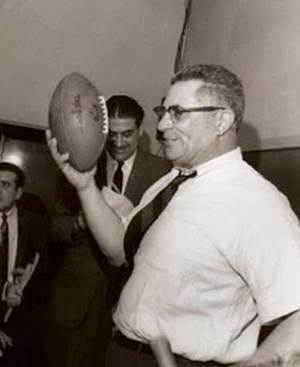
Lombardi FootballPiano

What’s the connection between Vince Lombardi and a grand piano? It’s all about the unintended consequences of impatience.

I’ve always been interested in music. I began with trumpet in the 4th Grade band at Monfort Heights Elementary School in Cincinnati, Ohio. Then I added electric guitar  with a few of my buddies. We were a basement band– not a garage band. Eventually, I realized that playing piano (we’d now say “keyboards”) would add a great deal to my versatility. So I started lessons with the nicest teacher you could ever imagine– and that was a problem. She taught me what I wanted to know, but…

So let’s cut to Vince Lombardi, winner of the first ever AFL-NFL World Championship, later known as Super Bowl I. On January 15, 1967, Lombardi’s Green Bay Packers of the National Football League (NFL) beat the American Football League (AFL)’s Kansas City Chiefs, 35-10, at Memorial Coliseum in Los Angeles. (If you’re not a football fan, hang in there–I hope you’ll get something out of this…).

Lombardi did not begin with a “super” team. In July 1961 the 38 members (it’s now 53 players with a head coach and 15 assistant coaches– more than you may have wanted to know!) of the Green Bay Packers football team were gathered together for the first day of training camp. The previous season had ended with a heartbreaking defeat when the Packers squandered a lead late in the 4th quarter and lost the NFL Championship to the Philadelphia Eagles. In his best-selling book, When Pride Still Mattered: A Life Of Vince Lombardi, author David Maraniss explains what happened when Lombardi walked into training camp in the summer of 1961.

Vince took nothing for granted. He began a tradition of starting from scratch, assuming that the players were blank slates who carried over no knowledge from the year before. He began with the most elemental statement of all. “Gentlemen,” he said, holding a football in his right hand, “this is a football.”

Lombardi’s methodical coverage of the fundamentals continued throughout training camp. Though they were impatient to get to actual plays and scrimmages, each player reviewed his assignment: how to block, tackle, run, pass and catch. They opened the playbook and started from page one. At some point, Max McGee, the Packers’ Pro Bowl wide receiver, joked, “Uh, Coach, could you slow down a little? You’re going too fast for us.” Lombardi reportedly cracked a smile, but continued his obsession with the basics all the same. His team would become the best in the league at the tasks everyone else took for granted. Six months later, the Green Bay Packers beat the New York Giants 37-0 to win the NFL Championship. [adapted from a blog http://jamesclear.com/vince-lombardi-fundamentals.]

According to “A Football Life” video on Lombardi’s coaching life, his players didn’t see the ball for the first two weeks of training camp. That tried their patience! He made them focus on the fundamental physical conditioning and habits that would be essential to being productive with the football.

I see a principle here: Spiritual life must have a firm foundation in both understanding and practice. There are no shortcuts. Knowing and living the “basics” of faith are essential for growth and maturity.

“In fact, though by this time you ought to be teachers, you need someone to teach you the elementary truths of God’s word all over again. You need milk, not solid food! 13 Anyone who lives on milk, being still an infant, is not acquainted with the teaching about righteousness. 14 But solid food is for the mature, who by constant use have trained themselves to distinguish good from evil” (Hebrews 5:12-14 NIV).

So back to piano. I was impatient to be able to play familiar songs as soon as possible. So my teacher taught me a few basics and then put songs in front of me I wanted to learn to play. I could figure them out, slowly, following the fingerings she wrote on the music. She wanted to motivate me—and it worked for a while. But when I discontinued my lessons, I couldn’t figure things out on my own. On the other hand, my friend, Tom, had a teacher who made him learn scales in all keys. And his teacher taught Tom to play Bach’s Two Part Inventions in all keys. Eventually, Tom could transpose (change the basic key) any piece of music on sight. He could modulate (change from one key to another through a progression of notes or chords) in a variety of ways. Tom is a master of performance on the keyboard. Me? Well, I play guitar.

You see, I was too impatient—and my dear teacher catered to me. Impatience, even for the best results, can undermine growth and success.

I’ve learned that the process is the product. Day by day, prayer by prayer, verse by verse, book by book, worship service by worship service, choice by choice, conversation by conversation, mistake-repentance-and-forgiveness by mistake-repentance-and-forgiveness, we are shaped into the likeness of Christ.


Sometimes it’s just being there

L_AMBIANCE BUILDING COLLAPSE
The rescue effort to retrieve 28 men from the collapse of L’Ambiance Plaza in Bridgeport, Connecticut in April 1987

It happened a long time ago—but the experience speaks to me almost daily.

On Thursday, April 23, 1987, I turned on the television at the end of one of our delightful, sun-drenched vacation days in Florida to hear the national news report on the collapse of L’Ambiance Plaza, a 13-story building under construction in Bridgeport, Connecticut—about 4 miles from our home at the time. Of the 70 men working at the site, 28 were missing under the tons of concrete and steel.

When we returned from Florida on Monday, a few days later, I immediately joined the Pastoral Care Team that was providing a round-the-clock presence at the site. By Wednesday, seven days into the disaster, they had recovered 16 bodies and were still searching for the remaining 12. I went to the disaster site from 9:00 p.m. – 2:00 a.m. for my shift on the Pastoral Care Team to be available to the families, construction workers, police, fire-fighters and medical personnel.

In all candor, I felt helpless and unimportant at the edge of the pit. They had located 4 more bodies, but it would be hours before they could get to them. What could I do?

Around midnight I was talking with one of the union bosses I’d gotten to know who’d been there from the very beginning.

“I’m so glad you’re here,” Mike said, “This place is like hell — and we need to know God’s still around.”

His simple affirmation chastened me. I had fallen into the lie that the twisted pile of rubble represented the “real world” and that my “spiritual resources” were of little use. Mike didn’t expect me to dig through concrete, use a torch, operate a crane or provide medical care. He had plenty of people to do that. He needed me to be there as a visible representative of God. Not to explain. Not to fix. Simply to express God’s presence in the midst of tragedy.

We often think too little of ourselves. We forget God can move through our simple, caring presence. I think this is, in part, what Henri Nouwen (professor at Yale and Harvard, author and spiritual director) means when he calls us “living reminders.” In the following quote he speaks of ministers and pastors, but the idea applies to all Jesus’ disciples. Nouwen reminds us that our primary value is who we are as witnesses of our Lord.

What are the spiritual resources of ministers? What prevents them from becoming dull, sullen, lukewarm bureaucrats, people who have many projects, plans and appointments but who have lost their heart somewhere in the midst of their activities? … Nihls Dahl, speaking about early Christianity, says: “The first obligation of the apostle vis-a-vis [in relationship to] the community– beyond founding it– is to make the faithful remember what they have received and already know– or should know.” [Henri J. M. Nouwen, The Living Reminder: Service and Prayer in memory of Jesus Christ, Minneapolis: The Seabury Press, 1977, 11].

“Remember what you have received and already know– or should know.” And remind others, too. What should we know?

The Lord himself goes before you and will be with you; he will never leave you nor forsake you. Do not be afraid; do not be discouraged”  Deuteronomy 31:8 (NIV).

But now, this is what the Lord says—
he who created you, Jacob,
he who formed you, Israel:
“Do not fear, for I have redeemed you;
I have summoned you by name; you are mine.
2 When you pass through the waters,
I will be with you;
and when you pass through the rivers,
they will not sweep over you.
When you walk through the fire,
you will not be burned;
the flames will not set you ablaze.
3 For I am the Lord your God,
the Holy One of Israel, your Savior (Isaiah 42:1-3).

In a world that emphasizes power, many things remind us of our lack of power: like severe weather, political conflict, terrorist attacks, buildings collapsing, addictions, “irreconcilable differences,” and natural disasters, to name a few. We, as God’s people, are living reminders to help the faithful recall the truth of the gospel and the resources of faith, hope and love God has provided in Christ. We are also witnesses to the watching world that, in spite of the worst the world can do people, God can meet them in the darkness and bring light.

But you will receive power when the Holy Spirit comes on you; and you will be my witnesses…” Acts 1:8 (NIV).

There are many ways to witness. Sometimes it’s just being there– and responding as God leads.